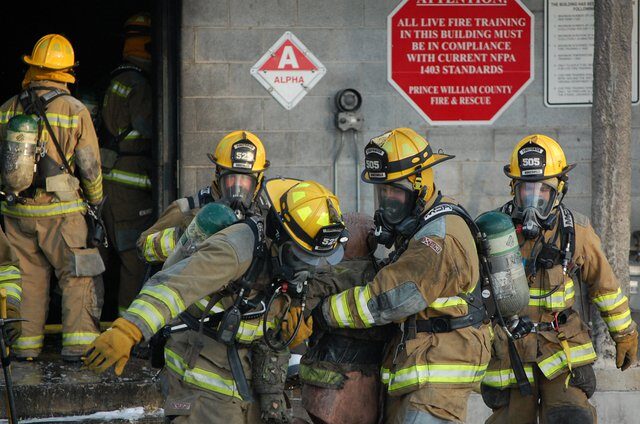
In conjunction with becoming a red hat, or shortly thereafter, members begin formal firefighter training at the Prince William County Public Safety Training Center in Nokesville, VA. Most classes are held two evenings a week and one day on the weekend. The academy has a large burn building that provides live fire exercises for realistic training. Classes are a combination of lectures in the classroom and practical, hands-on skill testing under the direction of some of Prince William County's most experienced fire instructors.
Firefighter I teaches the basics of firefighting including equipment use, fire behavior, ladders, extrication, rescue, ventilation, and safety. One full day is devoted to automotive firefighting, and two days are devoted to rescue scenarios. Near the end of the course, two days are spent working through the burn building in live fire exercises. During these structure fire days, crews will face six or seven real house fires in an eight-hour shift.
Firefighter II course teaches more advanced skills, some basic command decision making, and many more structure fire scenarios. Firefighter II includes another day of structural firefighting, including standpipe evolutions and interior attacks with large diameter attack lines.
HazMat Awareness, Operations, & Technician. With interstate highways, railways, and hazardous material processing and storage in the county, HazMat training is a must. Hazardous Materials management is taught at a variety of levels including HazMat Awareness, which teaches identification and evaluation of hazardous materials; HazMat Operations which covers containment and mitigation of hazardous materials and gross decontamination; and finally, HazMat Technician which is the most advanced level of hazardous materials training. Extensive training in supervising a hazardous materials incident and dealing with extremely difficult hazardous materials situations is conducted during the Technician level course.
Emergency Vehicle Operator Course (EVOC) II & III. Driving a fire truck is not quite like driving your average car or even a large SUV. It takes special skills to handle the heavy and large emergency vehicles in traffic and under stressful response conditions. To this end, driver candidates are certified in EVOC, and for fire apparatus, that typically includes class II (Ambulances) or class III (Pumpers and Trucks).
Officer I, II, and III. The Officer series teaches fire leaders incident command, fire attack strategy and tactics, fire investigation, management, administration, human resources, and other related disciplines.
Instructor I helps experienced firefighters become better instructors by teaching how to teach. The course teaches teaching techniques and then requires each student to give a fire department-related presentation as part of the final exam. Instructor II & III teach how to create lesson plans and how to put together a course outline to teach classes within the fire service.